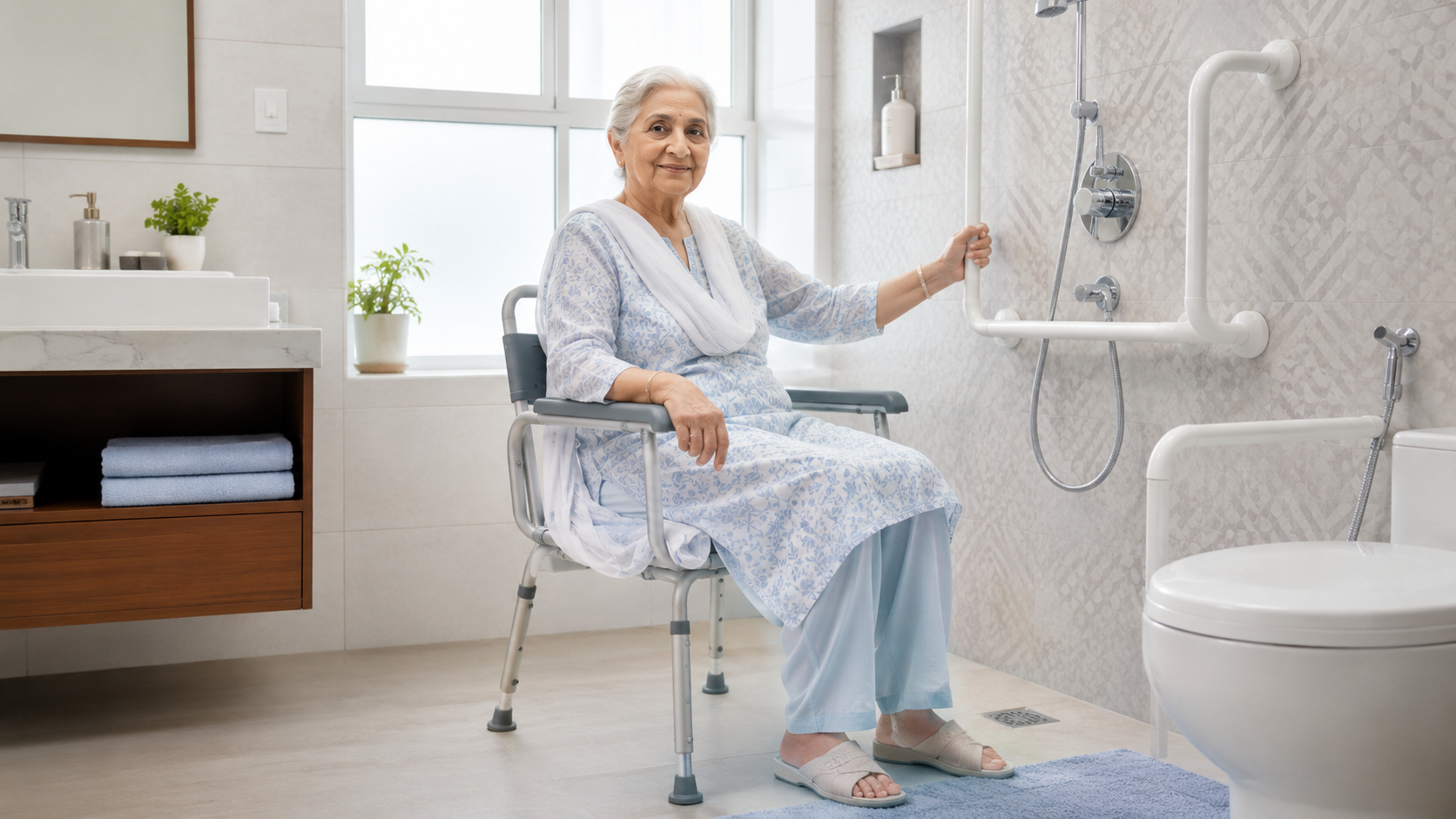
Toilet and commode support
Toilet or commode support, raised toilet seating and free-standing toilet frames considered around transfer ability and available space.
Begin here when a child or adult has difficulty using a toilet, commode, bath or shower, needs support during bathroom transfers, or cannot maintain a comfortable and adequately supported position during daily hygiene routines. SafetyAid reviews the person’s movement, balance, transfer method, bathroom environment and caregiver support before discussing possible directions.
This pathway supports children, adolescents and adults with neurological, neuromuscular, acquired, progressive, disability-related or complex functional needs. Bathroom support may be temporary or long term and may change with health, growth, pain, balance, transfers, environment or caregiver circumstances.
No bathroom product or support method is suitable for everyone. Individual review, fitting, installation planning, caregiver instruction and professional input may be required.
Bathroom-support review may be considered when one or more of these daily difficulties are present.
These observations identify a possible pathway but do not confirm that a particular bathroom product, rail, chair or transfer method is suitable.
Possible directions depend on individual review. These categories are not interchangeable, and no category is appropriate for every person.
Toilet or commode support, raised toilet seating and free-standing toilet frames considered around transfer ability and available space.
Shower chairs, bathing chairs, mobile shower or commode chairs and bath lifts considered conditionally.
Transfer benches, transfer aids and repositioning supports considered around the person, bathroom edge, threshold and caregiver plan.
Rails and wall-mounted supports considered only with suitable positioning, structure, fixing and intended use.
Foot, arm, trunk or head support considered when individual positioning and equipment compatibility have been reviewed.
Bathroom access, space planning, caregiver-assisted routines and adapted or custom solutions where appropriate.
A toilet frame or raised toilet seat changes the support and transfer demands around toileting.
A shower chair or bathing chair provides seated support but does not remove transfer, supervision or fall risk.
A mobile shower or commode chair may involve separate review of brakes, wheels, foot supports, access space and caregiver handling.
A transfer bench supports movement across a bathroom threshold or bathing edge but is not automatically suitable for every transfer method.
A grab rail provides a handhold only when its position, fixing, structure and intended use are suitable.
Descriptions on this page do not confirm suitability.
Diagnosis, photographs, age or basic measurements alone cannot confirm a bathroom product, rail position, installation method or transfer direction.
No bathroom product is automatically suitable, and no chair, rail, commode or transfer aid prevents every slip or fall.
Wet floors, soap, water, loose mats, thresholds, floor-level changes, restricted space and caregiver fatigue can change bathroom risk.
The person should not be left unsupported when individual supervision or assistance is required. Falls, near-falls or changing balance require reassessment.
Stop and seek appropriate review if bathroom activity causes pain, distress, dizziness, faintness, breathing difficulty, skin injury, loss of circulation or repeated instability.
Final configuration may require fitting, installation review, adjustment and further follow-up. No safety, functional or therapeutic outcome is guaranteed.
Grab rails and wall-mounted supports require review of the person’s transfer method, grip, reach, balance and direction of movement.
Wall construction, fixing points, structural strength, product capacity and installation method must be suitable for the intended load and use.
Suction-mounted rails are not equivalent to permanently fixed structural rails. Towel rails, plumbing fixtures or improvised handles must not be treated as transfer supports.
Rail height, position and direction should not be prescribed universally from this page. Installation must follow applicable product, structural and professional guidance.
A grab rail does not eliminate fall risk.
Transfers to and from toilets, commodes, bath areas and shower equipment require review of weight-bearing ability, balance, surface heights, available space and caregiver capacity.
Sit-to-stand ability must not be assumed. Caregivers should not attempt lifting or transfers beyond their physical capacity, training or available assistance.
Unsupported pivots, uncontrolled lowering and unplanned lifting should not be assumed appropriate. The number of helpers and the entry or exit method may affect the suitable direction.
Bathroom equipment must not be used to compensate for an unsuitable transfer plan. Caregiver instruction may be required before routine use.
Body weight and equipment capacity must be confirmed separately. Seat width, appearance or cushioning alone does not confirm suitability.
Seat height changes transfer demands and must be reviewed in relation to the person and surrounding surfaces.
Arm supports, foot supports, brakes, wheels, lateral supports and head supports are device-specific. Wheeled bathroom equipment must not be treated as stationary without reviewing its intended use, brakes, wheel configuration and floor surface.
No bathroom chair or commode is automatically suitable for unattended use. Components must not compromise breathing, circulation, skin, comfort, communication or voluntary movement.
Belts, harnesses, lateral supports, head supports, leg supports, pommels and similar components are positioning components—not general restraints.
They require individual fitting and must not be used merely to restrict movement or compensate for unsuitable equipment.
Fit and tension must not compromise breathing, swallowing, circulation, skin, comfort, communication or voluntary movement.
Skin condition, sensation, pressure risk and time spent sitting may affect bathroom-equipment suitability. Soft padding or seat appearance does not confirm pressure suitability.
Reduced sensation may affect awareness of unsafe water temperature or skin irritation. Persistent redness, pain, burns, swelling or other skin changes require appropriate professional attention.
Equipment must be cleaned, dried and maintained according to the applicable instructions. Corrosion, damaged surfaces, loose components or worn brakes require review before continued use.
Bathroom transfers or equipment use should not be initiated or changed when there are unresolved fracture, joint, skin, circulation, respiratory, neurological, post-surgical or significant pain concerns without appropriate professional guidance.
The public assessment prepares a local browser draft. Nothing is automatically submitted, and no official case, case ID, quotation, order, approval or product recommendation is created.
After reviewing the draft, the user decides what information to copy and deliberately share with SafetyAid.
Complete measurements are not required to begin. Additional measurements, photographs, videos or professional observations may be requested later.
Media and records should only be shared when requested, through an appropriate pathway and with suitable consent.
Complete measurements are not required to begin. If measurements are requested, use the approved Bathroom Measurements guide and record the unit, date and who took them.
Do not attempt an unsafe toilet, bath or shower transfer merely to obtain a measurement. Use “Not sure” or “Unable to measure safely” rather than guessing.
Record toilet, chair, commode, bath, threshold, doorway and other dimensions only when they can be accessed safely.
Confirm body weight and equipment capacity separately. Measurements do not independently confirm product suitability, structural installation feasibility or transfer safety.
Professional input may be important for uncertain weight-bearing, complex transfers, pain, fixed posture, skin concerns, repeated falls, grab-rail positioning, structural installation questions, post-surgical restrictions or difficult bathing and toileting routines.
Relevant observations may come from a physiotherapist, occupational therapist, rehabilitation physician, nurse, builder or accessibility professional within their appropriate scope.
Professional involvement is not mandatory for every first enquiry and does not automatically select, prescribe or approve equipment.
Professional collaboration creates no automatic registration, Professional ID, account or case access.
Children may require reassessment as they grow. Adults may require reassessment when health, pain, balance, weight-bearing ability, body weight, skin condition, transfer method, caregiver support or environment changes.
Equipment and supports should not simply be oversized for future growth. Fitting, installation review, caregiver instruction, follow-up and adjustment may be required after delivery.
Changes after an approved specification or production scope may affect price and timeline. International remote review cannot confirm every bathroom, transfer, installation or fitting factor.
The equipment destination determines the route—not the submitter’s location, residence or nationality.
Use when equipment will be delivered and used in Pakistan. Assessment, installation coordination, fitting, delivery and follow-up depend on location, equipment type, building conditions and confirmed scope.
Pakistan SupportUse when equipment will be delivered and used outside Pakistan. Feasibility may depend on dimensions, weight, folding, disassembly, packaging, battery or electrical features, destination requirements, local building conditions and available support. International in-person fitting or installation is not standard.
International & ExportThis page is the specialist bathroom, toileting and bathing pathway within the broader SafetyAid Support Areas.
SafetyAid provides equipment-focused review and guidance. It does not diagnose or provide treatment.
Bathroom equipment does not replace physiotherapy, occupational therapy, nursing, rehabilitation, building assessment or local clinical care.
Professional observations may inform review but do not automatically prescribe the final equipment or installation. No safety, functional or therapeutic result is guaranteed.
It is equipment-focused guidance for toileting, bathing, hygiene, positioning and related transfers after individual ability, environment and caregiver support have been reviewed.
Yes. The pathway supports children, adolescents and adults with temporary, long-term, neurological, neuromuscular, acquired, progressive, disability-related or complex functional needs.
No. Balance, weight-bearing, transfers, positioning, space, installation conditions and caregiver support affect the possible direction.
They address different seating, toileting, transfer and handhold needs. Each requires separate review and none removes all supervision, transfer or fall risk.
No. A suitably selected and installed rail may provide a handhold, but it does not eliminate fall risk.
Yes. Complete measurements are not required to begin. Use “Not sure” or “Unable to measure safely” rather than guessing.
It may be important for complex transfers, pain, skin concerns, repeated falls, grab-rail positioning, structural questions, surgery-related restrictions or difficult bathroom routines.
No. It prepares a local browser draft and does not automatically create a case, case ID, quotation, order, approval or product recommendation.
No. This page explains the bathroom-support pathway but does not confirm a product, installation or configuration. Begin with the assessment so the person’s abilities, transfers, bathroom environment and caregiver support can be reviewed.
Start the local assessment draft, use the approved bathroom-measurement guidance when needed, or contact SafetyAid for general pathway help.