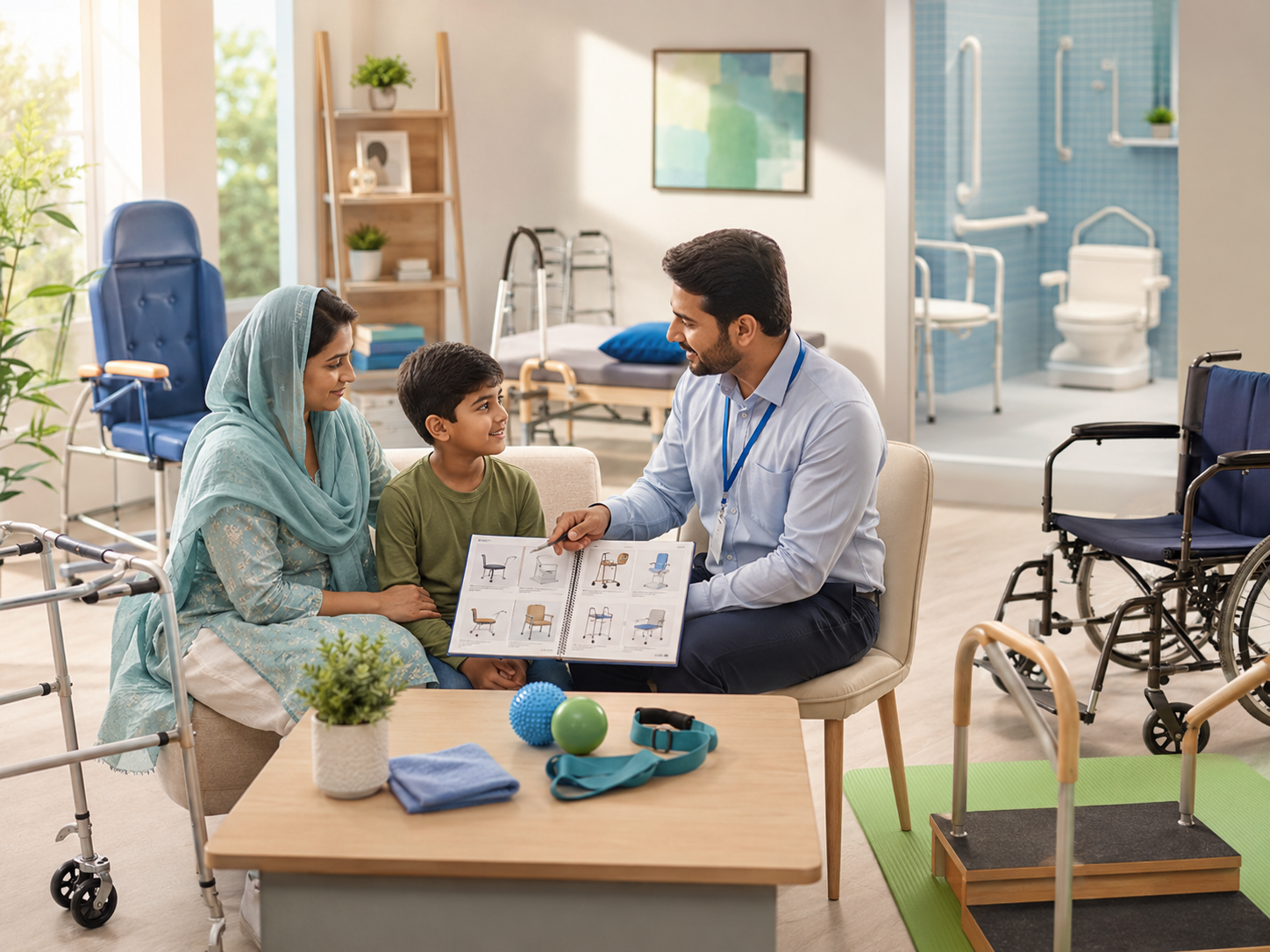
Seating and positioning
For difficulty maintaining a stable, supported sitting position for daily activities. Options may include supportive seating, cushions, head or trunk support and adapted positioning, subject to individual review.
Start with the person’s daily functional need rather than a product name or appearance. Explore six support areas for children and adults with neurological, neuromuscular, acquired neurological, disability-related and complex functional needs.
Use this page when you know the main difficulty involves sitting, standing, mobility, transfers, bathroom activities or home accessibility.
Use Life-Stage & Condition Pathways when you prefer to begin with an age group, condition, caregiver context or delivery route.
Pehle rozmarrah ki zaroorat, posture, movement, transfer, bathroom routine aur home setup samjhein, phir munasib support area dekhein.
The support-area cards identify the main functional need. They do not confirm a product, configuration or final suitability.
For difficulty maintaining a stable, supported sitting position for daily activities. Options may include supportive seating, cushions, head or trunk support and adapted positioning, subject to individual review.
For people who need support to stand or bear weight. Standing frames and positioning supports may be considered after reviewing posture, tolerance, precautions, caregiver support and environment.
For difficulty walking, stepping or moving with appropriate support. Walkers, gait trainers and mobility supports may be considered according to balance, control, environment and assistance needs.
For bed, chair, toilet and other daily transfers, repositioning and caregiver-assistance needs. Transfer equipment and handling methods depend on the person, caregiver capacity and available space.
For toileting, bathing and bathroom-transfer needs. Options may include commode, bathing, grab-support and hygiene equipment after reviewing the equipment user and bathroom environment.
For doorway, bedroom, walking-route, ramp, rail and other home-access barriers. Recommendations depend on the person’s mobility, the environment and the agreed installation scope.
Use Life-Stage & Condition Pathways when you want to begin with childhood, adulthood, ageing, cerebral palsy, stroke, neurological needs, caregiver context or delivery route.
Explore Life-Stage & Condition PathwaysMeasurements are not always required at the beginning. The assessment allows users to indicate whether measurements are unavailable, partly available, professionally recorded or uncertain.
Do not attempt measurements, standing, walking or transfers that may cause pain, instability or risk.
Measurement GuidesBegin with the functional need, daily environment and available caregiver support. Complete measurements are not required to start.
The public assessment prepares a local browser draft for review. Nothing is automatically submitted, and no case, quotation, order or product recommendation is created from this page.
Professional input may be helpful in some situations but is not mandatory for every enquiry and does not automatically determine the final equipment choice.
Start AssessmentIdentifies the main functional need: seating, standing, mobility, transfers, bathroom support or home accessibility.
The equipment destination determines Pakistan Support or International & Export.
Collects the person-specific, environmental and caregiver information required for review.
No product is automatically suitable. Product appearance alone cannot confirm fit, configuration or safety.
Do not attempt unsupported standing, unsafe walking, difficult transfers or measurements that may cause pain, instability or risk.
Caregiver capacity, available space, daily environment and equipment destination may affect the suitable direction. Final configuration may require fitting, adjustment or further review.
SafetyAid provides equipment-focused review and guidance. It does not provide diagnosis or treatment, and equipment does not replace therapy or local clinical care.
Professional input may help in some cases but is not mandatory for every enquiry and does not automatically determine the equipment choice. No therapeutic result is guaranteed.
A support area is one of six functional-need pathways: seating, standing, mobility, transfers, bathroom support or home accessibility. It is a starting point for review, not a product selection.
Begin with the main daily difficulty. Some basic items may be easier to understand, but appearance or category alone cannot confirm suitability. Where positioning, standing, mobility, transfer or environmental risks are involved, individual review is important.
Yes. Complete measurements are not required to start. Record whether measurements are unavailable, partly available, professionally recorded or uncertain.
Not for every enquiry. Professional observations may help where available, especially when precautions or complex needs are involved, but they do not automatically determine the equipment choice.
A support area describes the functional need. A delivery route is based on whether the equipment destination is in Pakistan or outside Pakistan.
No. The assessment prepares a local browser draft for manual review. It does not automatically submit information or create a case, quotation, order or product recommendation.
Additional information may be requested after the initial assessment. Media or records should only be shared when requested, through an appropriate pathway and with suitable consent.
Use the assessment to record the functional need, environment, caregiver context and delivery destination for review.