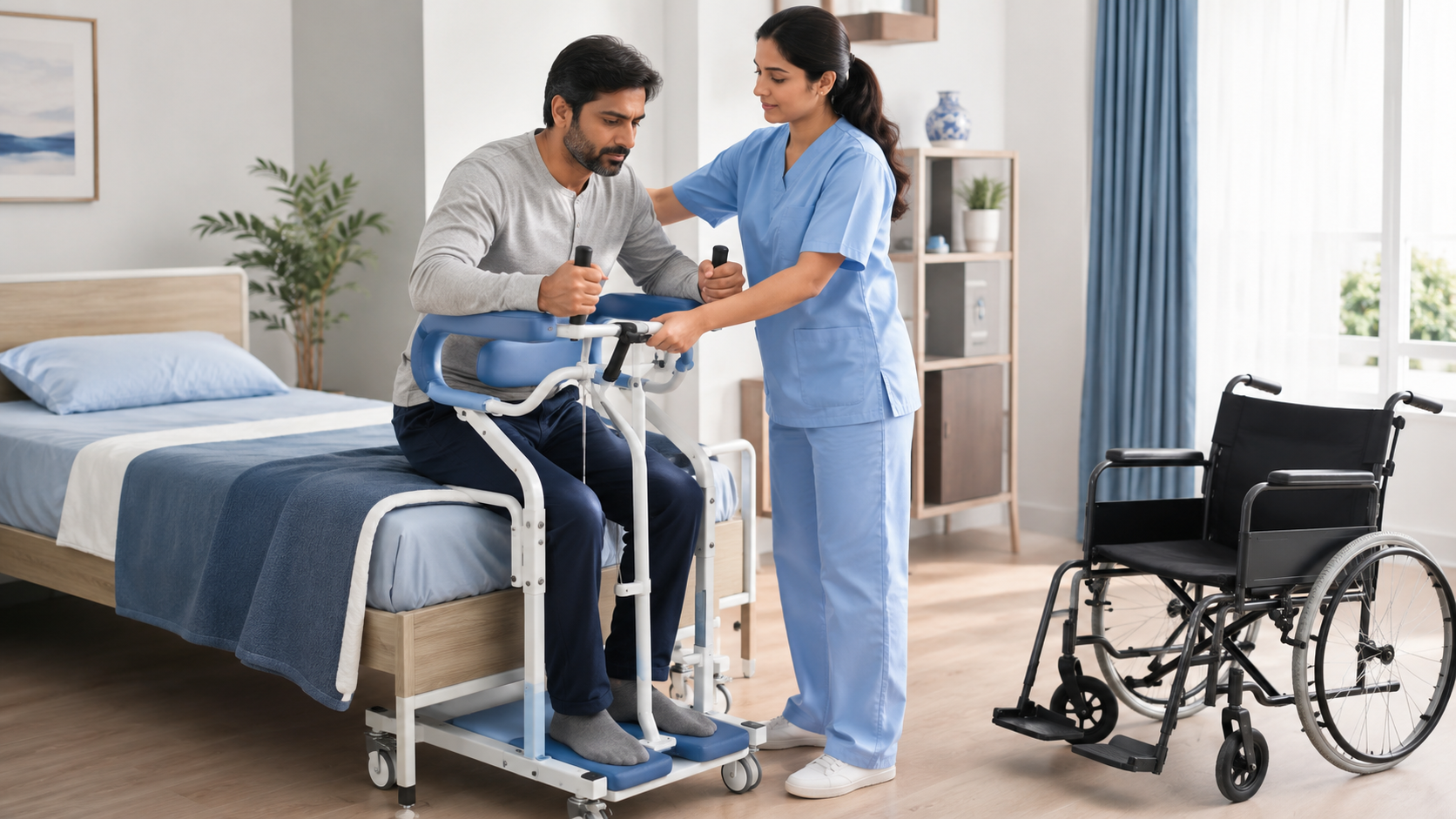
Transfer, repositioning and daily-care support

Transfer and daily-care support for children and adults

Begin here when a child or adult has difficulty moving between a bed, chair, wheelchair, toilet or another daily position. SafetyAid reviews ability, transfer method, environment and caregiver capacity before discussing possible directions.

No transfer method or device suits everyone. Needs may be temporary or long term, and individual review, fitting, caregiver instruction or professional input may be required.

Transfer-support equipment considered during an individual equipment review
Transfer and repositioning guidance begins with the person, environment and available caregiver support.
Functional needs

When transfer and daily-care review may help

Transfer review may be considered when one or more of these daily difficulties are present.

  • Difficulty moving between bed, chair or wheelchair
  • Difficulty transferring to or from a toilet, commode, bath or shower
  • Limited or uncertain weight-bearing ability
  • Pain, fatigue, fear or instability during movement
  • Need for repositioning or sit-to-stand support
  • Caregiver difficulty providing physical assistance
  • Limited bathroom, bedroom or doorway space
  • Changing ability or difficulty with existing equipment

These observations identify a possible pathway but do not confirm that a particular transfer device or method is suitable.

Conditional options

Possible transfer and repositioning directions

Possible directions depend on individual review. These categories are not interchangeable, and no category is appropriate for every person.

Transfers between daily surfaces

Bed-to-chair, wheelchair, toilet, commode, bathing and shower transfers considered around the person and environment.

Boards and turning aids

Transfer boards, pivot aids or turning aids considered only when participation, balance, movement and caregiver requirements are appropriate.

Sit-to-stand aids

Equipment that may assist a transition when weight-bearing ability, lower-limb support, upper-body control and participation have been reviewed.

Hoists and lifting systems

Mobile, floor-based or overhead systems considered with compatible lifting components and an individually reviewed sling.

Repositioning aids

Sheets and other aids considered for movement within a bed or seating surface rather than assumed transfers between surfaces.

Integrated or adapted support

Wheelchair entry, exit and positioning, caregiver-assisted planning and adapted or custom transfer directions where appropriate.

Individual review

What transfer review may consider

  • Current transfer method
  • Ability to sit, stand or bear weight
  • Posture, limb function and participation
  • Tone, pain, fatigue, fear or distress
  • Skin, joint, fracture or surgical precautions
  • Dizziness, breathing or seizure precautions
  • Body weight and equipment capacity
  • Transfer direction and distance
  • Surface heights, room and doorway space
  • Caregiver capacity and existing equipment
  • Home, school, clinic or workplace setting
  • Professional observations and precautions

Diagnosis, photographs, age or basic measurements alone cannot confirm a transfer method or device.

Essential safety boundaries

Safety, compatibility and caregiver capacity come first

Caregiver and fall risk

Caregivers should not attempt transfers beyond their capacity, training or available help. No device eliminates falling, uncontrolled lowering or caregiver-injury risk.

Hoists, slings and supports

Lifting components must be compatible and individually reviewed. Positioning supports are not general restraints and must not compromise breathing, circulation, skin, comfort or communication.

When professional review matters

Seek appropriate guidance for fracture, surgery, severe pain, skin or circulation concerns, breathing difficulty, fainting, uncontrolled seizures or repeated instability.

Stop and seek appropriate review if movement causes pain, distress, dizziness, breathing difficulty, colour change, swelling, skin injury or repeated instability.

Assessment workflow

Begin with the assessment draft

The public assessment prepares a local browser draft. Nothing is automatically submitted, and no official case, case ID, quotation, order, approval or product recommendation is created.

After reviewing it, the user decides what to copy and deliberately share. Measurements, media or professional observations may be requested later and should only be shared through an appropriate pathway with suitable consent.

Do not attempt an unsafe transfer to obtain a measurement. Use “Not sure” rather than guessing. Professional input may help with uncertain weight-bearing, pain, surgery-related precautions, hoist or sling review, skin concerns or repeated falls.

Actual environment

Transfer equipment must work within the actual environment

  • Caregiver capacity and available helpers
  • Bed, chair and wheelchair access
  • Doorway, turning and bathroom space
  • Wet surfaces, floor levels and thresholds
  • Storage, transport and manoeuvrability
  • Cleaning, charging and maintenance
  • Home, school, clinic or workplace routine
Growth and follow-up

Transfer needs may change

Reassessment may be needed with growth or changes in health, pain, strength, weight, skin, caregiver support or environment. Equipment and slings should not simply be oversized; fitting, instruction and follow-up may be required.

Delivery destination

Choose the route by equipment destination

The equipment destination determines the route—not the submitter’s location, residence or nationality.

Pakistan Support

Use when equipment will be delivered and used in Pakistan. Assessment, fitting, delivery and follow-up depend on location, equipment type and confirmed scope.

Pakistan Support

International & Export

Use when equipment will be delivered and used outside Pakistan. Feasibility may depend on equipment dimensions, weight, disassembly, packaging, battery or electrical features, destination requirements and available local support. International in-person fitting is not standard.

International & Export
Professional boundary

Equipment guidance does not replace clinical care

SafetyAid provides equipment-focused guidance—not diagnosis, treatment or emergency care. Transfer equipment does not replace local clinical care, and no safety, functional or therapeutic result is guaranteed.

FAQ

Transfer and daily-care questions

What is transfer and daily-care support?

It is equipment-focused guidance for moving or repositioning a person between daily surfaces after ability, transfer method, environment and caregiver support have been reviewed.

Does one transfer method suit every person?

No. Transfer direction depends on individual ability, participation, weight-bearing, precautions, environment, available helpers and caregiver capacity.

What is the difference between a transfer board, sit-to-stand aid and hoist?

A transfer board requires particular sitting and movement abilities. A sit-to-stand aid requires reviewed weight-bearing and participation. A hoist uses a compatible lifting system and individually reviewed sling.

Can I begin without complete measurements?

Yes. Complete measurements are not required to begin. Use “Not sure” or “Unable to measure safely” rather than guessing.

Does completing the assessment create an order?

No. It prepares a local browser draft and does not automatically create a case, case ID, quotation, order, approval or product recommendation.

Can transfer equipment be selected directly from this page?

No. This page explains the transfer pathway but does not confirm a device, sling or configuration. Begin with the assessment so the person’s ability, transfer method, environment and caregiver support can be reviewed.

Begin with individual transfer review

Start the local assessment draft, use the approved transfer-measurement guidance when needed, or contact SafetyAid for general pathway help.

WhatsApp