Supportive, adaptive or static seating
May be considered when standard seating does not provide the support required for daily activities.
Specialist seating and positioning support for CP and neurological needs.
This pathway supports children, adolescents and adults with neurological, neuromuscular, acquired, progressive, disability-related or complex functional needs. Seating needs may be temporary or long term and may change with growth, health, function, environment or routine.
Har bachay aur baray fard ki sitting needs mukhtalif ho sakti hain; pehle posture, comfort, routine aur support requirements samajhna zaroori hai.
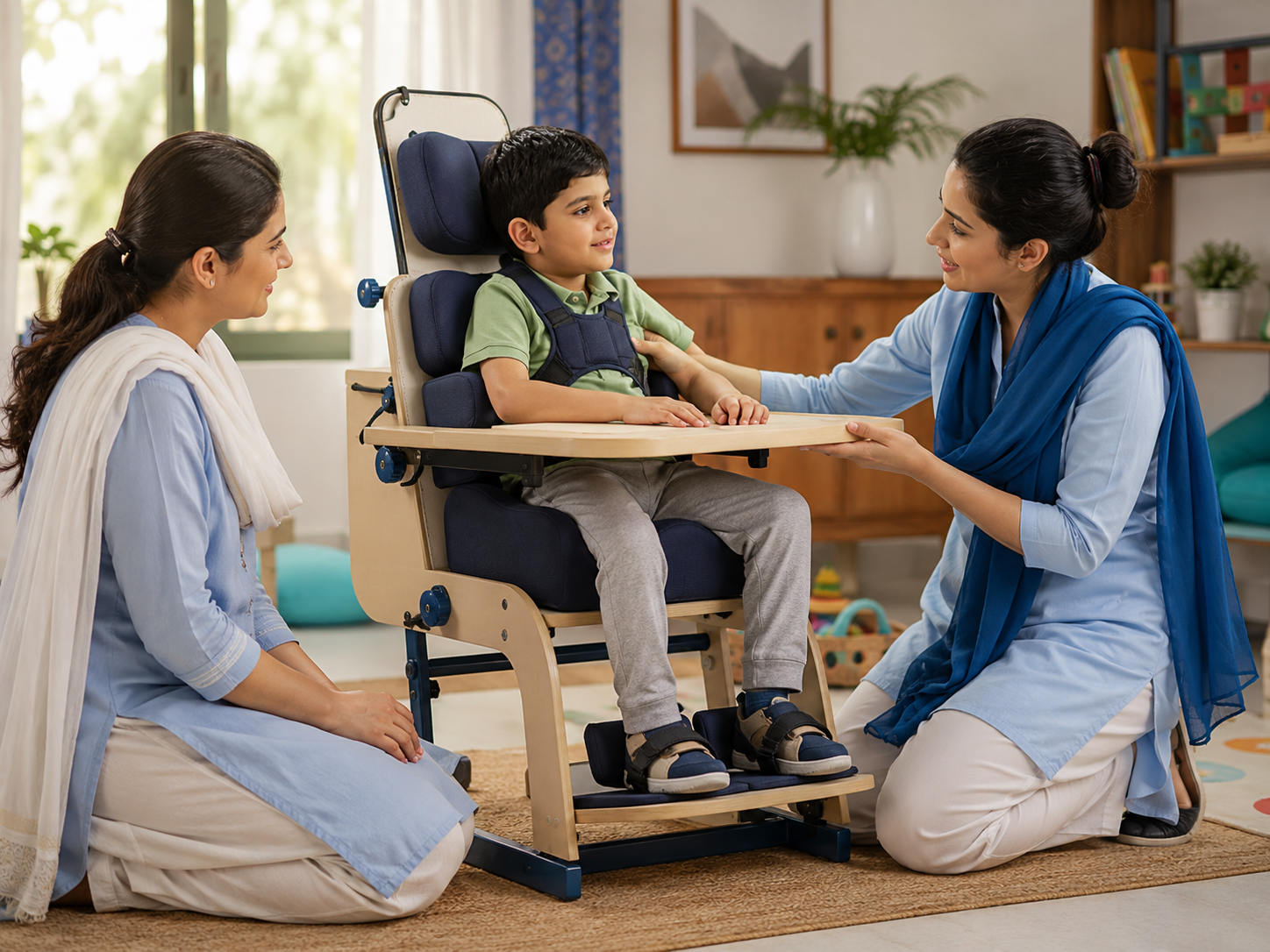
Seating review may be useful when a person slides, leans, collapses, becomes tired or uncomfortable, has limited head or trunk control, cannot use ordinary seating effectively, or needs additional support for communication, learning, work, meals, mobility or daily care.
These observations identify a reason for review; they do not confirm a product or configuration.
Possible directions depend on the individual assessment. No component is appropriate for every person.
May be considered when standard seating does not provide the support required for daily activities.
May include review of the seat, back support, posture, mobility access, transfers and compatibility with the existing wheelchair.
May be considered after reviewing posture, skin history, sensation, movement and time spent sitting.
Positioning components may be considered according to flexibility, comfort, movement, breathing, skin and support requirements.
Foot supports, arm supports and activity surfaces or trays may be considered according to access, posture and intended activities.
These directions require individual review and are not routine or universally suitable.
A diagnosis, age group or product appearance does not determine the seating configuration. Two people with the same diagnosis may need different support because posture, movement, comfort, daily activities, environment and caregiver circumstances differ.
Children may require growth-related adjustment. Adults may require reassessment when function, weight, health, pain, equipment condition, environment or daily routines change.
A photograph, diagnosis or basic measurement set alone cannot confirm seating suitability.
A diagnosis does not determine the final seating configuration. Two people with the same diagnosis may require different equipment directions.
Product appearance and photographs alone cannot confirm fit, configuration or suitability.
Posture should not be forced into a different position without understanding flexibility, comfort, pain, breathing and other relevant factors.
Individual goals, environment and caregiver support affect the possible direction.
No seating product is automatically suitable. Do not attempt unsupported or forced positioning.
Final configuration may require fitting, adjustment and further review.
Stop using the seating configuration and seek appropriate review if the person develops pain, distress, breathing difficulty, persistent skin redness, loss of circulation, increased instability or other concerning changes.
No therapeutic result is guaranteed.
Pelvic belts, chest harnesses, lateral supports, head supports, pommels and similar components are positioning components that require individual assessment, correct fitting and caregiver instruction.
They must not be used merely to restrict movement or compensate for an unsuitable seating configuration.
Fit and tension must not compromise breathing, swallowing, circulation, skin, comfort, communication or voluntary movement.
The person should not be left in a position that causes pain, distress, breathing difficulty or other concerning symptoms.
Pressure risk may depend on skin history, sensation, posture, movement and time spent sitting.
Cushion softness, thickness or appearance does not confirm suitability, and equipment alone does not eliminate pressure-injury risk.
Repositioning and qualified clinical review may be required.
Persistent redness, pain, heat, swelling or other skin changes need appropriate professional attention.
Seating may support posture and access during meals, but it does not establish swallowing or respiratory safety.
Coughing, choking, breathing difficulty, colour change or distress requires appropriate clinical review.
Seating equipment does not replace a swallowing or respiratory assessment where one is needed.
The public assessment prepares a local browser draft. Nothing is automatically submitted, and no official case, quotation, order or product recommendation is created.
After reviewing the draft, the user decides what information to copy and deliberately share with SafetyAid.
Complete measurements are not required to begin. Additional measurements, photographs, videos or professional observations may be requested later when relevant.
Photographs, videos or records should only be shared when requested, through an appropriate pathway and with suitable consent.
Start AssessmentComplete measurements are not required to begin. If measurements are requested, use the approved Seating Measurements guide and record the unit, date and who took them.
Measure only when the person can be positioned with adequate support. Use “Not sure” or “Unable to measure safely” rather than guessing.
Measurements do not independently confirm sizing or suitability.
Do not add growth allowance or make supports oversized without review.
Professional input may be useful where there is fixed asymmetry, pain, pressure risk, swallowing or respiratory concern, significant involuntary movement, complex transfers or other higher-risk seating needs.
Professional involvement is not mandatory for every initial enquiry and does not automatically determine the equipment choice.
Professional collaboration does not create automatic approval, registration, Professional ID, account access or case access.
Professional CollaborationReview should consider who positions and transfers the person, caregiver capacity, available space, table or desk access, doorways, transport, floor surfaces, home, school, clinic or workplace routines, cleaning, equipment weight, manoeuvrability, storage and available maintenance or adjustment support.
Powered or electrical features, where relevant, require separate review of charging, electrical compatibility and local support.
Children may require growth-related adjustment, and adults may require reassessment when function, weight, health, comfort, environment or routine changes.
Supports should not simply be made oversized for future growth.
Final fitting, follow-up and adjustment may be required.
Changes requested after specifications or production scope are approved may affect price and timeline.
International remote review cannot confirm every seating or fitting factor.
The equipment destination determines the route—not the submitter’s location, residence or nationality.
Use this route when the seating equipment will be delivered and used in Pakistan. Fitting, delivery and follow-up depend on location, equipment type and confirmed scope.
Choose Pakistan SupportUse this route when the seating equipment will be delivered and used outside Pakistan. Feasibility may depend on configuration, dimensions, weight, packaging and available local support. International in-person fitting is not standard; remote setup or local professional participation may be required.
Choose International & ExportUse Life-Stage & Condition Pathways when you prefer to begin with childhood, adulthood, cerebral palsy, stroke, neurological needs, ageing or caregiver context.
This page is the specialist seating and positioning pathway within the broader SafetyAid Support Areas.
Browse Support AreasSafetyAid provides equipment-focused review and guidance. It does not diagnose or provide treatment, and seating equipment does not replace therapy or local clinical care.
Professional observations may inform the review but do not automatically prescribe the final equipment.
No therapeutic outcome is guaranteed.
It is an assessment-led pathway for considering seating, positioning components and daily-use requirements. It does not confirm a product or configuration.
Yes. Children, adolescents and adults may use this pathway when sitting support needs individual review.
No. Posture, movement, comfort, activities, environment and caregiver circumstances may differ between people with the same diagnosis.
Yes. Complete measurements are not required to begin. Use the approved guide only if measurements are requested.
Professional input may help where there is pain, fixed asymmetry, pressure risk, swallowing or respiratory concern, significant involuntary movement or complex transfers.
This page begins with the person’s functional sitting need and may consider several seating directions. A product page describes one possible equipment type and does not establish suitability.
No. The assessment prepares a local browser draft. Nothing is automatically submitted, and no official case, quotation, order or recommendation is created.
No. This page explains the seating pathway but does not confirm a product or configuration. Begin with the assessment so the person, posture, environment and daily activities can be reviewed.
Additional information may be requested after the initial assessment. Media or records should only be shared when requested, through an appropriate pathway and with suitable consent.
Start with the individual assessment, use the approved measurement guide when requested, or choose the relevant support route.