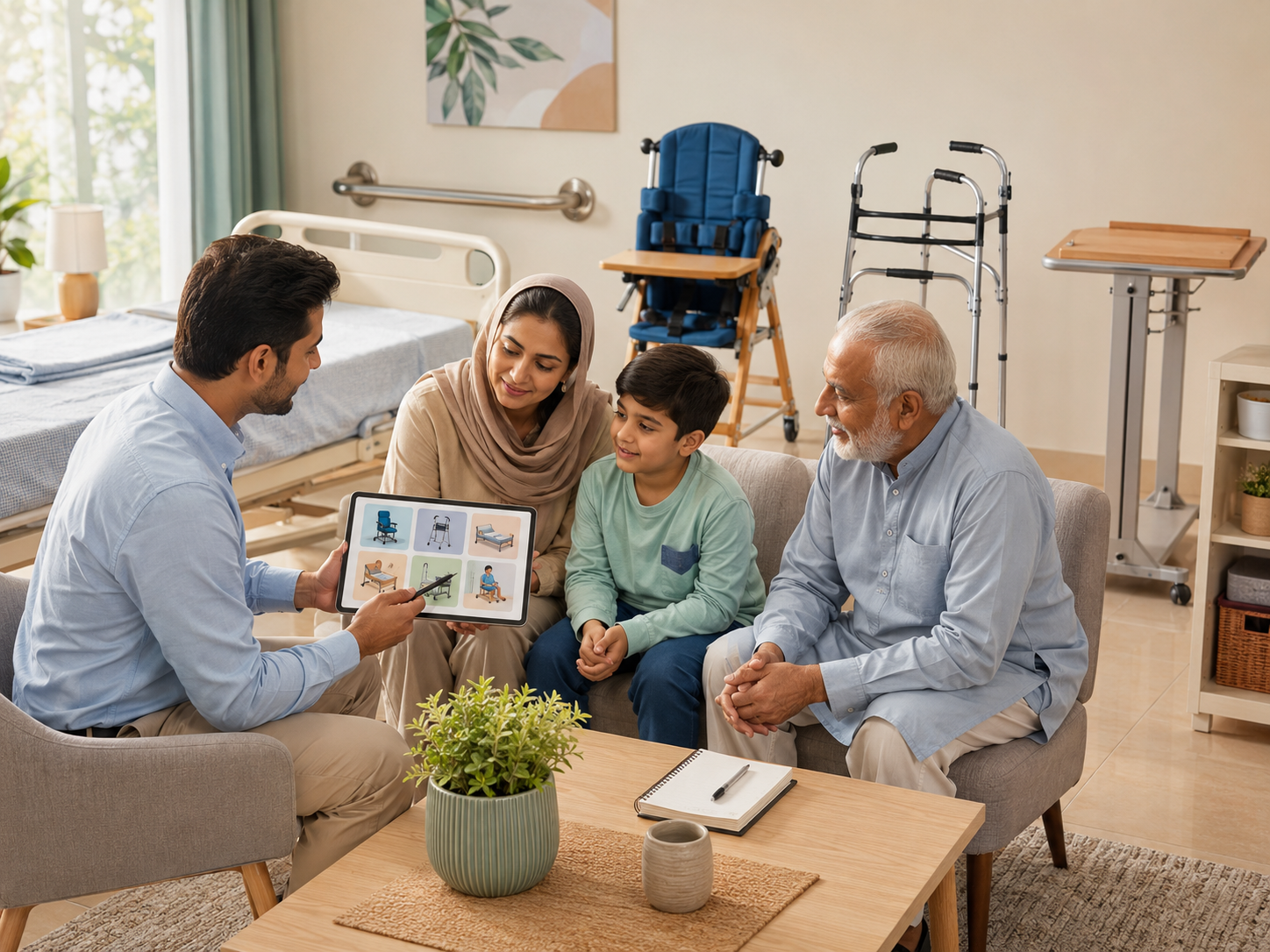
Pediatric Neurological Support
Guidance for children with neurological, neuromuscular, developmental or complex functional needs affecting posture, movement, mobility and daily participation.
Explore Pediatric Neurological SupportBegin with the person’s life stage, known condition, caregiver context or equipment destination. These pathways help children, adults, families, caregivers, professionals and institutions find the most relevant starting point without assuming that a diagnosis determines the equipment.
Use Support Areas when the main functional difficulty is clearer than the condition—for example sitting, standing, mobility, transfers, bathroom needs or home accessibility.
Begin here for children with developmental, neurological, neuromuscular or complex functional needs affecting posture, sitting, standing, mobility, daily care or participation. A diagnosis or product name does not determine the final equipment.
Guidance for children with neurological, neuromuscular, developmental or complex functional needs affecting posture, movement, mobility and daily participation.
Explore Pediatric Neurological SupportBegin here when cerebral palsy is the known context. Equipment direction still depends on the individual’s posture, mobility, environment, caregiver support and daily goals.
Explore Cerebral Palsy SupportA broader starting point for pediatric seating, standing, mobility, daily-care and participation needs where an assessment-led overview is useful.
Explore Pediatric Rehabilitation GuidanceBegin here for adults with neurological, neuromuscular, progressive or acquired needs affecting seating, mobility, transfers, bathroom routines, home access or caregiver support. People with the same diagnosis may require different equipment directions.
A broad starting point for adult neurological, neuromuscular, postural, mobility, transfer and daily-care needs.
Explore Adult Neurological SupportGuidance for stroke and other acquired neurological needs affecting posture, mobility, transfers, home routines and caregiver support.
Explore Stroke and Acquired Neurological SupportA general pathway when the neurological context is known but the most suitable life-stage or functional route remains uncertain.
Explore Neurological and Neuromuscular SupportBegin here for ageing-related mobility changes, recovery after surgery, temporary or long-term home-care needs and caregiver assistance. Age or surgery alone does not confirm equipment suitability.
Guidance for mobility changes, transfers, bathroom routines, home safety, accessibility and caregiver support during ageing or long-term home care.
Explore Ageing and Home-Care SupportGuidance for temporary or longer-term support after surgery, including mobility, transfers, bathroom needs, daily routines and home access.
Explore Post-Surgery SupportQualified professionals, clinics, hospitals, schools, NGOs and institutions may prepare a local collaboration request for equipment-focused review.
Nothing is automatically submitted, and no registration, approval, Professional ID, account, dashboard access or case access is created from this page.
Professional CollaborationThe equipment destination determines the route—not the submitter’s residence, nationality or current location.
Use this route when the equipment will be delivered and used in Pakistan. An overseas family member or professional may use this route for a recipient in Pakistan.
Choose Pakistan SupportUse this route when the equipment will be delivered and used outside Pakistan. A person in Pakistan may use this route for overseas delivery.
Choose International & ExportUse Support Areas when the main need involves sitting, standing, mobility, transfers, bathroom activities or home accessibility.
Browse Support AreasThe public assessment prepares a local browser draft. Nothing is automatically submitted, and no official case, quotation, order or product recommendation is created.
Complete measurements and professional involvement are not required to begin.
After reviewing the draft, the user decides what information to copy and deliberately share with SafetyAid.
Start AssessmentMeasurements may be requested after the initial assessment. Do not attempt unsafe positioning, standing, walking, transfers or measurements. Measurements do not independently confirm sizing, configuration or suitability.
Media or records should only be shared when requested, through an appropriate pathway and with suitable consent.
Measurement GuidesA diagnosis does not determine the final equipment. People with the same condition may have different posture, mobility, environment and caregiver needs.
Pathway selection provides a starting point, not a prescription or product recommendation.
If the functional difficulty is clearer than the diagnosis, browse Support Areas instead.
No product is automatically suitable, and appearance alone cannot confirm fit, configuration or safety.
Do not attempt unsupported standing, unsafe walking, difficult transfers or measurements that may cause pain, instability or risk.
Final configuration may require fitting, adjustment and further review. Environment, caregiver capacity and equipment destination may affect the suitable direction.
SafetyAid provides equipment-focused review and guidance. It does not diagnose or provide treatment, and equipment does not replace therapy or local clinical care.
Professional input may help in some situations but is not mandatory for every enquiry and does not automatically determine the equipment choice.
No therapeutic result is guaranteed.
It is a starting point based on age group, known condition, caregiver context, professional context or equipment destination. It does not select a product.
No. People with the same diagnosis may have different posture, mobility, environment and caregiver needs, so individual review remains important.
This page begins with life stage, condition or support context. Support Areas begins with a functional difficulty such as sitting, standing, mobility, transfers, bathroom needs or home accessibility.
Yes. Complete measurements are not required to begin. Measurements may be requested later when they are relevant and can be obtained without risk.
Not for every enquiry. Professional input may help in some situations but is not mandatory and does not automatically determine the equipment choice.
No. The assessment prepares a local browser draft. Nothing is automatically submitted, and no official case, quotation, order or recommendation is created.
Choose according to where the equipment will be delivered and used. The submitter’s residence, nationality or current location does not determine the route.
Additional information may be requested after the initial assessment. Media or records should only be shared when requested, through an appropriate pathway and with suitable consent.
Begin with the pathway closest to the person’s context, or prepare individual information for review.