Seating & Positioning
For posture, supported sitting, comfort and participation needs that require assessment-led review.
Begin here when a child or adolescent needs specialist support with posture, seating, standing, stepping, walking or mobility. SafetyAid reviews function, risks, environment and caregiver circumstances before discussing equipment directions.
Support may be relevant for cerebral palsy, spina bifida, muscular dystrophy, developmental disabilities, neuromuscular disorders, acquired brain injury, spinal conditions and other complex functional needs.
A diagnosis, age, photograph or product category alone does not confirm equipment suitability.
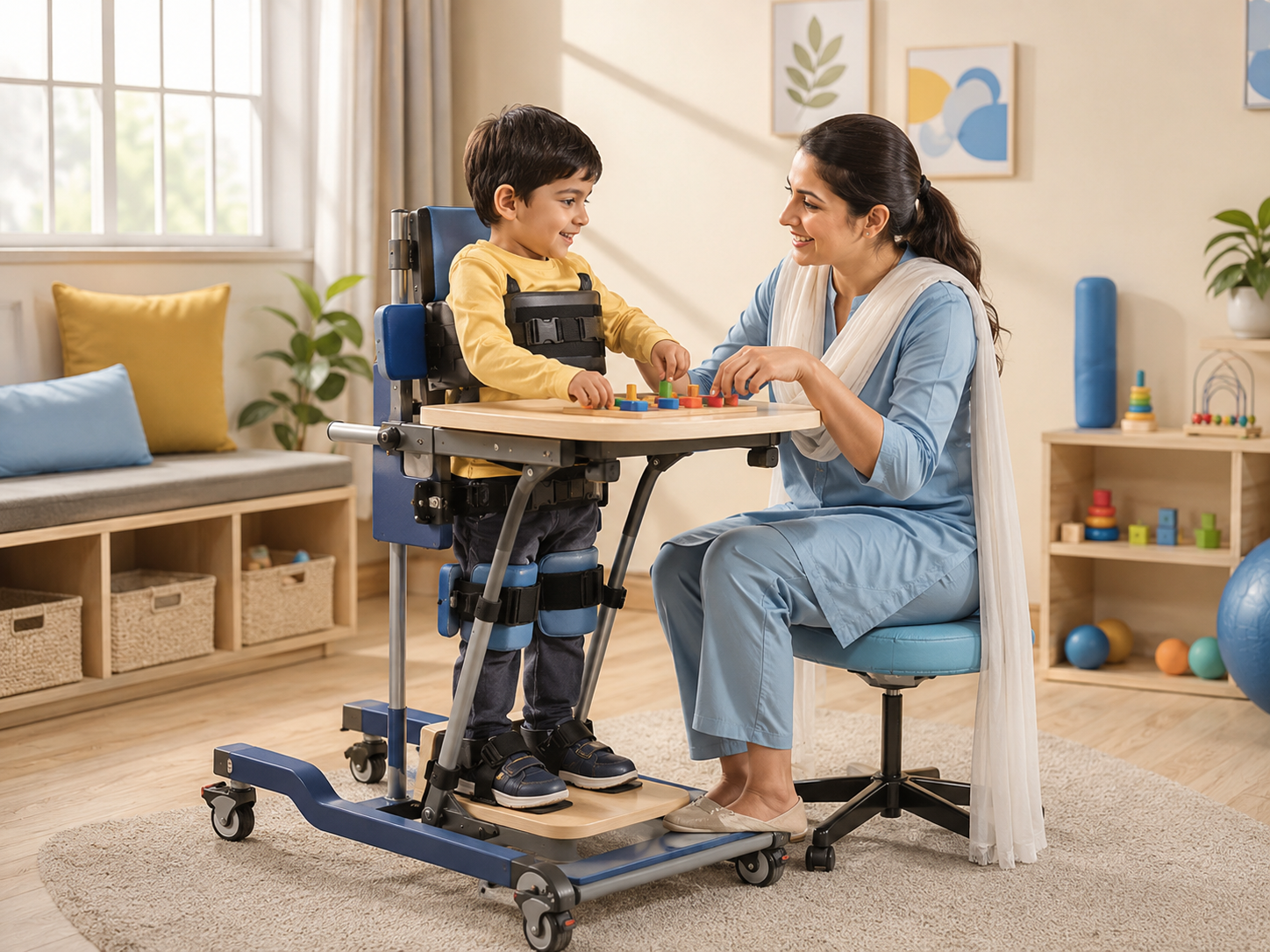
Start with the broad support area. Detailed support levels, measurements, configuration and case-specific recommendations are handled later through the appropriate Professional Assessment or active equipment-case pathway.
For posture, supported sitting, comfort and participation needs that require assessment-led review.
For supported standing and upright participation when suitability requires individual review.
For walking, stepping or mobility needs that may require a walker, gait trainer or another mobility pathway after assessment.
For moving between daily surfaces when function, caregiver support or environment affects the safe equipment pathway.
For bathing, toileting, positioning, home routines and participation needs that are part of the child’s broader support picture.
For children or adolescents with more than one support need, or when the correct equipment pathway is not yet clear.
For straightforward product shopping and general rehabilitation fulfilment in Pakistan, continue to RehabMart. SafetyAid is the assessment-led pathway when fit, function, support level or case complexity requires specialist review.
SafetyAid supports children with cerebral palsy and other developmental, neurological or neuromuscular conditions when the assistive-technology need falls within seating, standing or gait and mobility.
GMFCS may help describe current mobility but does not select or prescribe equipment.
Functional abilities, posture, transfers, pain, skin risk, environment, caregiver support and participation goals require separate review.
The CP pathway remains one specialist pathway within broader pediatric and adolescent assistive-technology support.
Diagnosis, GMFCS level, photographs, age or basic measurements alone cannot confirm equipment suitability.
Equipment use should not be initiated or changed when there are unresolved pain, fracture, joint, skin, respiratory, neurological, feeding, swallowing or post-surgical concerns without appropriate professional guidance.
SafetyAid provides equipment-focused review and guidance. It does not diagnose or provide medical, feeding, swallowing or therapeutic treatment.
Equipment does not replace physiotherapy, occupational therapy, speech and language therapy, nutrition, rehabilitation or local clinical care.
No safety, functional or therapeutic outcome is guaranteed.
Feeding-position support relates only to posture and equipment configuration.
It does not assess swallowing safety, prescribe food or liquid consistency, or replace speech and language therapy, medical or nutritional review.
Coughing, choking, breathing difficulty, colour change, repeated chest concerns or distress during feeding require appropriate professional attention.
No feeding, swallowing or dietary instructions are provided on this page.
Children and adolescents may require reassessment as they grow or when health, posture, mobility, pain, skin condition, school routine, transport, caregiving or environment changes.
Equipment should not simply be oversized for future growth.
Growth allowance must not compromise current posture, transfers, breathing, circulation, skin, comfort, communication or function.
Fitting, caregiver instruction, follow-up and adjustment may be required after delivery.
Changes after an approved specification or production scope may affect price and timeline.
Review the child’s comfort, dignity, communication and voluntary participation, current abilities, family routines and priorities.
Consider school, transport, home, current equipment, professional guidance and the support available in each setting.
Consider caregiver strength and handling limits, plus the number and capability of available helpers.
The free Initial Screening collects only enough information to understand the broad need and identify the appropriate next pathway.
A successful Initial Screening submission may create an enquiry reference for follow-up. It does not create a quotation, approve equipment, authorize an order or provide a case-specific recommendation.
Detailed measurements, extensive photographs, videos and professional reports are not required at the first stage.
If the enquiry progresses, SafetyAid will request only the information needed for the appropriate Professional Assessment or active equipment-case stage.
Information about a child, media, measurements and records should only be shared when specifically requested through the appropriate pathway and with suitable parent or guardian consent.
Professional input may be important for complex posture, pain, hip or joint concerns, skin risk, orthotics, feeding position, swallowing concerns, breathing concerns, seizures, surgery, transfers or uncertain equipment use.
Relevant observations may come from a physiotherapist, occupational therapist, rehabilitation physician, speech and language therapist, orthotist, nurse, nutrition professional or another appropriately qualified professional within their scope.
Professional involvement is not mandatory for every first enquiry and does not automatically select, prescribe or approve equipment.
Professional collaboration creates no automatic registration, Professional ID, account or case access.
The equipment destination determines the route—not the submitter’s location, residence or nationality.
Use when equipment will be delivered and used in Pakistan. Assessment, fitting, delivery and follow-up depend on location, equipment type and confirmed scope.
Use when equipment will be delivered and used outside Pakistan. Feasibility may depend on dimensions, weight, growth allowances, disassembly, packaging, destination requirements and available local fitting or professional support. International in-person fitting is not standard.
For general rehabilitation equipment in Pakistan, use RehabMart.
Begin with Initial Screening so SafetyAid can understand the broad support need and identify the appropriate next pathway before any detailed recommendation or configuration.