Static or upright standing supports
Equipment that maintains an upright supported position when that direction is appropriate.
Specialist standing and weight-bearing support for CP and neurological needs.
This pathway supports children, adolescents and adults with neurological, neuromuscular, acquired, progressive, spinal, disability-related or complex functional needs. Standing support may be temporary or long term and may change with growth, health, function or routine.
No standing option is suitable for everyone. Recommendations remain assessment-led and may require professional input, individual fitting and caregiver instruction.
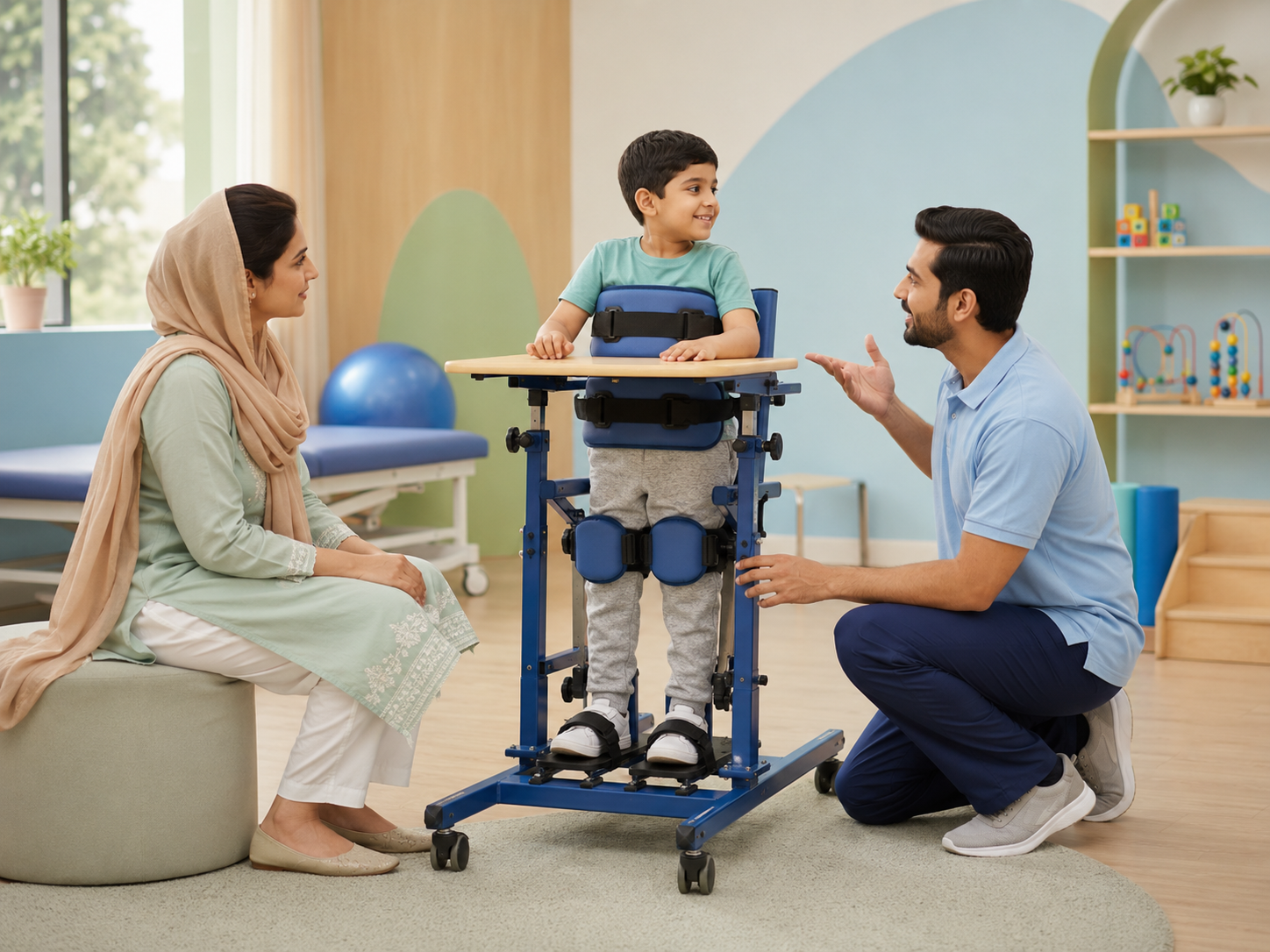
Standing review may be considered when one or more of these functional needs are present.
These observations identify a possible pathway but do not confirm that standing equipment is suitable.
Possible directions depend on individual assessment. No standing category is appropriate for every person, and the categories are not interchangeable.
Equipment that maintains an upright supported position when that direction is appropriate.
Different positioning directions that require separate assessment of support, angle, tolerance and precautions.
Systems that may assist a transition or maintain standing when the required handling and support have been reviewed.
Standing considered alongside trays, activity surfaces and access to tasks at standing height.
Device-specific mobility while supported upright, considered separately from gait training or independent walking.
Standing used alongside orthoses, seating or transfer routines, including adapted or custom systems where appropriate.
Supported standing maintains an upright position with equipment assistance.
Gait trainers and walkers support stepping or walking.
Mobility and Gait SupportSit-to-stand and transfer equipment address transitions and assisted handling.
Transfer and Daily-Care SupportA standing frame is not automatically a gait trainer or transfer device, and supported standing does not guarantee future walking.
A diagnosis, photograph, age or basic measurement set alone cannot confirm standing suitability.
A diagnosis, age group or product appearance does not determine the standing configuration. Two people with the same diagnosis may need different support because movement, joint range, comfort, precautions, transfer method, environment and caregiver circumstances differ.
A diagnosis does not determine which standing option, if any, is appropriate. Review is based on current function, comfort, available movement, weight-bearing tolerance, medical precautions, transfers, environment and caregiver support.
Product appearance and photographs do not confirm suitability. Joints and posture must not be forced to match equipment.
Children may require growth-related adjustment. Adults may require reassessment when health, pain, function, weight, orthoses, standing tolerance, environment or routines change.
No standing product is automatically suitable. Do not attempt unsupported or forced standing.
Standing angle, duration, frequency and progression require individual review and must not be prescribed casually from this page.
Stop and seek appropriate review if standing causes pain, distress, dizziness, faintness, breathing difficulty, colour change, swelling, persistent skin redness, loss of circulation or instability.
Final configuration may require fitting, adjustment and further review. No functional or therapeutic outcome is guaranteed.
Standing should not be initiated or progressed when there are unresolved medical, fracture, joint, skin, circulation, respiratory or post-surgical concerns without appropriate professional guidance.
Pelvic belts, chest, trunk and lateral supports, knee blocks or straps, footplates, heel loops, foot straps, head supports, pommels and trays are positioning components that require individual assessment, fitting and caregiver instruction.
They must not be used merely to restrict movement or compensate for unsuitable equipment. Fit and tension must not compromise breathing, circulation, skin, comfort, communication or voluntary movement.
Knees and feet must not be forced into painful positions. The person must not be left in a position that causes pain, distress, breathing difficulty or other concerning symptoms.
Entry into and exit from a standing system must be reviewed as part of the equipment plan. Brakes, locks, supports and contact points should be checked before use.
A standing frame must not be treated as a transfer device unless it is specifically designed and confirmed for that function. Unsupported pivots or lifting beyond caregiver ability should not be attempted.
Fall and tipping risks depend on the equipment configuration, floor surface, available space and assistance required. Moving an occupied standing system is device-specific and must follow the applicable approved instructions.
Supported standing may be considered as part of an individual rehabilitation or daily-positioning plan, but expected benefits and precautions require qualified review.
Standing equipment does not guarantee changes in bone density, hip position, joint range, contracture risk or skeletal development.
Standing equipment should not be presented as guaranteeing improvements in circulation, bowel function, digestion, breathing, alertness, sleep or general wellbeing.
Any expected therapeutic or systemic benefit requires qualified review and is not guaranteed.
The public assessment prepares a local browser draft. Nothing is automatically submitted, and no official case, case ID, quotation, order, approval or product recommendation is created.
After reviewing the draft, the user decides what information to copy and deliberately share with SafetyAid.
Complete measurements are not required to begin. Additional measurements, photographs, videos or professional observations may be requested later.
Photographs, videos and records should only be shared when requested, through an appropriate pathway and with suitable consent.
Complete measurements are not required to begin. If measurements are requested, use the approved Mobility, Walker & Standing Measurements guide and record the unit, date and who took them.
Measure only in a stable, adequately supported position. Use “Not sure” or “Unable to measure safely” rather than guessing.
Confirm body weight and equipment capacity separately. Measurements do not independently confirm sizing, suitability or safety. Do not add growth allowance or oversize supports without review.
Professional input may be important where there are medical precautions, restricted movement, pain, orthoses, post-surgical requirements, complex transfers or uncertainty about standing tolerance.
Relevant observations may come from a physiotherapist, occupational therapist, rehabilitation physician, orthotist or another appropriately qualified professional.
Professional involvement is not mandatory for every first enquiry and does not automatically select, approve or prescribe equipment.
Professional collaboration creates no automatic approval, registration, Professional ID, account or case access.
Footwear, AFOs, KAFOs or other orthoses may affect measurements, foot position, pressure and equipment compatibility.
Their presence does not automatically make standing appropriate. Feet, knees and hips must not be forced into position. Orthotic decisions remain within the scope of appropriately qualified professionals.
Review should consider who transfers and positions the person, caregiver strength and handling limits, the number of available helpers, room and doorway dimensions, level floor surfaces, home, school, work or therapy use, activity-surface height, equipment weight, manoeuvrability, storage, transport, cleaning, maintenance, caster and brake use and available adjustment support.
Powered standing features, where relevant, require separate review of charging, electrical compatibility and local technical support.
Children may need reassessment as they grow. Adults may require reassessment when health, pain, function, weight, standing tolerance, orthoses, environment or caregiver support changes.
Standing components should not simply be made oversized for future growth. Fitting, caregiver instruction, follow-up and adjustment may be required after approval or delivery.
Changes after specifications or production scope are approved may affect price and timeline. International remote review cannot confirm every standing or fitting factor.
The equipment destination determines the route—not the submitter’s location, residence or nationality.
Use this route when the standing equipment will be delivered and used in Pakistan. Fitting, delivery and follow-up depend on location, equipment type and confirmed scope.
Pakistan SupportUse this route when the standing equipment will be delivered and used outside Pakistan. Feasibility may depend on frame dimensions, weight, disassembly, packaging, destination requirements and available local support. International in-person fitting is not standard; remote setup or local professional participation may be required.
International & ExportUse Life-Stage & Condition Pathways when you prefer to begin with childhood, adulthood, cerebral palsy, stroke, neurological needs, ageing or caregiver context.
This page is the specialist standing and weight-bearing pathway within the broader SafetyAid Support Areas.
SafetyAid provides equipment-focused review and guidance. It does not diagnose or provide treatment, and standing equipment does not replace physiotherapy, rehabilitation or local clinical care.
Professional observations may inform review but do not automatically prescribe the final equipment. No therapeutic outcome is guaranteed.
It is equipment-assisted upright positioning considered after individual function, precautions, transfers, environment and support requirements have been reviewed.
Yes. The pathway supports children, adolescents and adults, including people with neurological, neuromuscular, acquired, progressive, spinal, disability-related or complex functional needs.
No. Supported standing maintains an upright position, while gait trainers and walkers support stepping or walking. Transfer equipment addresses transitions and assisted handling.
No. Diagnosis alone does not determine whether standing equipment is appropriate or which configuration may be considered.
Yes. Complete measurements are not required to begin. Use “Not sure” or “Unable to measure safely” instead of guessing.
It may be important where there are medical precautions, pain, restricted movement, orthoses, post-surgical requirements, complex transfers or uncertainty about standing tolerance.
No. The assessment creates a local browser draft. It does not automatically create a case, case ID, quotation, order, approval or product recommendation.
No. This page explains the standing pathway but does not confirm a product or configuration. Begin with the assessment so function, precautions, transfers, environment and caregiver support can be reviewed.
Additional information may be requested after the initial assessment. Media or records should only be shared when requested, through an appropriate pathway and with suitable consent.
Start the local assessment draft, use the approved measurement guidance when needed, or contact SafetyAid for general pathway help.