Comfortable sitting
Difficulty maintaining a comfortable sitting position, side leaning, sliding or loss of alignment.
Begin with what the child can currently do, what they are trying to do, their comfort, communication, preferred activities, daily routines and the environments in which support will be used.
SafetyAid reviews posture, movement, participation, caregiver circumstances and home, school, transport or community requirements before discussing possible equipment directions.
The child’s diagnosis, age, height, weight, classification level, photographs, previous equipment or a visible product card do not independently confirm suitability.
Equipment may support function and participation, but it does not independently provide therapy, diagnose a condition or guarantee developmental progress.
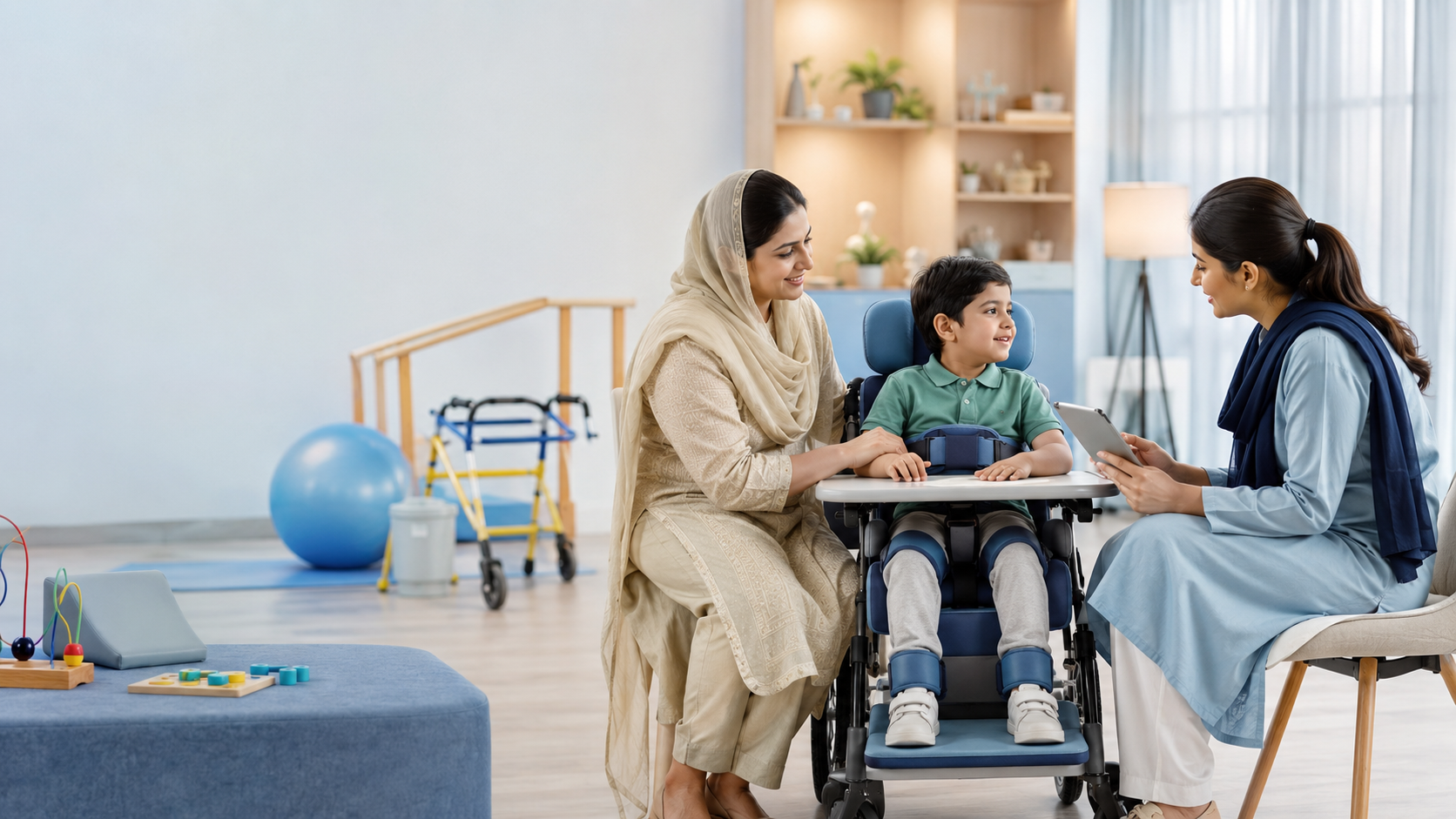
Illustrative support setting. Equipment direction requires individual assessment, fitting and follow-up.
Difficulty maintaining a comfortable sitting position, side leaning, sliding or loss of alignment.
Limited head, trunk or pelvic control.
Difficulty standing, bearing weight, walking or using current mobility equipment.
Need for supported movement or mobility exploration.
Difficulty transferring between daily surfaces.
Difficulty with bathing, toileting or hygiene routines.
Pain, fatigue, fear or distress during activity.
Feeding-position or swallowing concerns.
Skin or pressure-risk concerns.
Changes in tone, stiffness or involuntary movement.
Difficulty communicating discomfort or refusal.
Caregiver difficulty during transfers or daily care.
Barriers at home, school, transport or community locations.
Temporary, changing, progressive or long-term support needs.
These observations identify possible pathways. They do not confirm that a particular chair, stander, walker, gait trainer, commode, bathing aid or transfer device is suitable.
Sudden, severe or rapidly worsening symptoms require appropriate local emergency or medical services rather than an equipment enquiry.
Do not wait for a website assessment, email, contact form or WhatsApp response in an emergency.
SafetyAid’s specialist pediatric scope is seating and positioning, standing and weight bearing, and gait or walking mobility. General rehabilitation equipment remains connected through RehabMart.
Postural seating, head and trunk support, pelvic and foot positioning, comfort and participation.
Supported standing, alignment, upright positioning and weight-bearing.
Gait trainers, supportive walkers, assisted stepping and mobility configuration.
Bathroom, toileting, transfer, homecare and accessibility equipment may still be needed, but general product supply in Pakistan is handled through RehabMart rather than presented as a core SafetyAid pathway.
Diagnosis, age, height, weight, GMFCS or another classification level, photographs, videos, previous equipment, family preference, school request or a general professional suggestion do not independently determine the suitable product or configuration.
Children with similar diagnoses or classification levels may have very different posture, movement, pain, sensation, communication, cognition, tolerance, environments and goals.
The child’s current abilities, risks, comfort, participation, environment, caregiver circumstances and personal preferences require separate review.
SafetyAid provides equipment-focused review and guidance. It does not diagnose, classify disability severity, prescribe treatment or provide medical clearance.
The child’s strengths, abilities, goals, preferred activities and participation priorities.
Head, trunk and pelvic control; sitting, standing, weight-bearing, limb function, tone, stiffness and involuntary movement.
Joint range, contractures, hip, spinal, joint or bone precautions, orthotics and prescribed supports.
Pain, fatigue, fear, distress, skin condition, pressure risk, sensation and circulation concerns.
Breathing, respiratory, seizure, feeding-position and swallowing concerns.
Vision, hearing, cognition, attention, behaviour, sensory preferences, communication and ability to express discomfort or refusal.
Growth, expected physical changes, body weight and equipment capacity.
Existing equipment and home, school, transport and community environments.
Caregiver strength, availability and training, professional observations, family routines and the child’s own preferences.
Measurements, photographs, diagnosis or age alone cannot confirm equipment suitability.
Pediatric equipment requires individual assessment, fitting, user and caregiver guidance and appropriate follow-up.
Growth, changes in posture, movement, body weight, orthotics, daily routines or environments may require adjustment, reconfiguration, reassessment or replacement.
A successful initial fitting does not remove the need to monitor comfort, skin, alignment, function and participation.
Equipment suitable at home may require separate review for school, transport, therapy or community use.
No single size, model or configuration is suitable for every child.
Do not continue using equipment that has become too small, unstable, damaged, uncomfortable or inconsistent with the child’s current needs.
Equipment use or adjustment should not proceed when there are unresolved medical, orthopedic, respiratory, neurological, feeding, swallowing, skin or pain concerns without appropriate professional guidance.
Significant or unexplained pain, suspected fracture, bone fragility, unstable joints, hip or spinal precautions.
Persistent redness, skin injury, swelling, circulation concerns or altered sensation.
Breathing or respiratory difficulty, uncontrolled or changing seizures.
Rapid or unexplained loss of function or new or significant weakness.
Feeding or swallowing concerns, coughing, choking, gagging, altered breathing or change in colour during meals, recurrent chest infections or distress.
Prescribed postoperative or orthopedic restrictions and intolerance during equipment use.
Equipment does not replace pediatric, rehabilitation, physiotherapy, occupational therapy, speech and language therapy, nursing, orthopedic, respiratory, nutrition or other appropriate clinical care.
No safety, developmental, mobility, postural, feeding, therapeutic or participation outcome is guaranteed.
A supportive sitting position may form part of an individualized feeding plan, but a chair, head support, harness, tray or cushion does not independently confirm that eating or drinking is safe.
Coughing, choking, gagging, altered breathing, change in colour, recurrent chest infections, prolonged meals or distress during eating and drinking require appropriately trained professional review.
Feeding and swallowing assessment, food or fluid modification, aspiration-risk decisions and feeding techniques are outside SafetyAid’s equipment-selection scope.
Equipment must not force the head, neck or trunk into a position that compromises breathing, swallowing, comfort or communication.
Seat width, appearance, cushioning or age range alone does not confirm postural or pressure suitability.
Head, trunk, pelvic, arm, leg and foot support must be reviewed together.
Belts, harnesses, lateral supports, head supports, leg supports, pommels and similar components are positioning components—not general restraints.
They must not be used merely to stop movement, punish behaviour or compensate for unsuitable equipment.
Fit must not compromise breathing, swallowing, circulation, skin, comfort, communication or voluntary movement.
Supports should not force the child into an unsupported range or position.
Persistent redness, pain, breathing change, distress or loss of circulation requires appropriate review.
Standing equipment requires review of permitted weight-bearing, bone and joint precautions, hip and spinal status, alignment, orthotics, pain, fatigue, breathing, circulation and the child’s participation.
A standing device does not independently provide therapy or guarantee hip, bone, contracture, digestive, respiratory or developmental outcomes.
Do not force the child into a standing angle, joint range or duration they cannot safely tolerate.
Standing equipment must not be introduced against medical, orthopedic or postoperative restrictions.
Stop use and seek appropriate review when there is pain, distress, breathing difficulty, skin injury, circulation change or repeated instability.
A child who can step with assistance is not automatically suitable for every walker or gait-training device.
Review may include head and trunk control, upper-limb use, weight-bearing, alignment, orthotics, balance, endurance, cognition, communication, motivation, environment and caregiver support.
A walker or gait trainer does not guarantee independent walking, developmental progress or fall prevention.
Indoor suitability does not confirm suitability for school corridors, ramps, thresholds, outdoor routes, transport or every floor surface.
Equipment must not drag, suspend, force or restrain the child in a manner inconsistent with its intended function.
Stop use and seek review if equipment causes pain, distress, breathing difficulty, skin injury, circulation change or repeated instability.
Transfer ability, caregiver support and available space may affect seating, standing or gait configuration. General transfer equipment in Pakistan is handled through RehabMart.
Sit-to-stand ability must not be assumed.
Caregivers should not attempt lifting or transfers beyond their physical capacity, training or available assistance.
Unsupported pivots, uncontrolled lowering and unplanned lifting should not be assumed appropriate.
The number and capability of helpers may affect the suitable method.
Equipment cannot compensate for an unsuitable transfer or daily-care plan.
Caregiver instruction may be required before routine use.
Bathroom and toileting needs may be important to the child and family, but general bathroom equipment is not a core SafetyAid pathway. Pakistan product supply is handled through RehabMart.
No bathing chair, commode, rail or support makes a child safe without appropriate use and supervision.
Fixed rails and supports require suitable fixing, capacity and placement.
Suction rails, towel rails and improvised handles are not equivalent to suitable structural supports.
Equipment must not obstruct drainage, exits, door operation, caregiver access or emergency routes.
A child must not be left unattended merely because support equipment is present.
Review should consider how the child communicates comfort, discomfort, fear, pain, refusal and preferences.
Parents or guardians may provide consent where appropriate, while the child’s age-appropriate assent, participation and expressed preferences should also be respected.
The child should not be forced to remain in equipment that causes pain, distress, breathing difficulty, skin injury, loss of circulation or sustained fear.
Privacy and dignity are particularly important during measurements, transfers, bathing, toileting and personal-care routines.
Photographs, videos, medical records, school records and personal information should only be shared when requested, through an appropriate pathway and with suitable parent or guardian consent.
Where another person submits information, they should have appropriate authority to do so.
This page does not determine legal custody, guardianship, capacity or consent authority.
Equipment must not be used as punishment, coercion or an unauthorized restraint.
Concerns that a child is being harmed, forced, neglected or placed in unsafe equipment should be addressed through appropriate local safeguarding and professional channels.
SafetyAid’s specialist pediatric scope is seating and positioning, standing and weight bearing, and gait or walking mobility. General rehabilitation equipment remains connected through RehabMart.
Postural seating, head and trunk support, pelvic and foot positioning, comfort and participation.
Supported standing, alignment, upright positioning and weight-bearing.
Gait trainers, supportive walkers, assisted stepping and mobility configuration.
Bathroom, toileting, transfer, homecare and accessibility equipment may still be needed, but general product supply in Pakistan is handled through RehabMart rather than presented as a core SafetyAid pathway.
The public assessment prepares a local browser draft. Nothing is automatically submitted, and no official case, case ID, quotation, order, approval or product recommendation is created.
The parent, guardian, caregiver or professional reviews the draft and decides what information to copy and deliberately share with SafetyAid.
Complete measurements, photographs, videos, medical records, school records and professional reports are not required to begin.
Additional information may be requested later after the child’s functional pathway, environment and relevant precautions are understood.
Personal information, media and records should only be shared when requested, through an appropriate pathway and with suitable consent.
Current abilities, preferred activities, communication, comfort and participation priorities.
Sitting, standing, mobility, transfers, tone, tolerance and current supports.
Home, school, transport, community, bathing, toileting and daily-care circumstances.
Pain, skin, hips, spine, bones, breathing, seizures, feeding, swallowing and professional restrictions.
A functional support pathway may be discussed; no product is automatically selected or approved.
Configuration, fitting, caregiver guidance, monitoring, adjustment and reassessment as required.
Complete measurements are not required to begin. First identify the relevant functional pathway through the pediatric assessment draft.
If measurements are requested, use the applicable approved guide and record the unit, date and person taking them.
Do not force sitting, standing, walking, reaching, joint movement or transfers merely to obtain a measurement.
Do not remove orthotics, braces, splints or prescribed supports unless an appropriately qualified professional has specifically advised that this is safe.
Use “Not sure” or “Unable to measure safely” rather than guessing.
Measurements and photographs do not independently confirm fitting, capacity, clinical suitability or safety.
Growth or changes in posture and function may require measurements and fitting to be reviewed again.
Professional input may be important when posture, hips, spine, joints, weight-bearing, pain, pressure, breathing, seizures, feeding, swallowing, communication, transfers, growth or environmental access affect equipment use.
Relevant observations may come from a pediatrician, rehabilitation physician, physiotherapist, occupational therapist, speech and language therapist, orthotist, nurse, nutrition professional, teacher, special educator or another appropriately qualified professional within their scope.
Professional involvement is not mandatory for every first enquiry and does not automatically select, prescribe or approve equipment.
Professional collaboration creates no automatic registration, Professional ID, account or case access.
Professional CollaborationThese pathways help organize an enquiry but do not independently confirm equipment suitability.
The equipment destination determines the route—not the parent, guardian or submitter’s location, residence or nationality.
Use when equipment will be delivered and used in Pakistan. Assessment, fitting, delivery and follow-up depend on location, equipment type, the child’s requirements and confirmed scope.
Pakistan SupportUse when equipment will be delivered and used outside Pakistan. Feasibility may depend on dimensions, weight, folding, disassembly, packaging, battery or electrical features, destination requirements and available local fitting or professional support. International in-person fitting is not standard.
International & ExportIt is equipment-focused support that may help a child with posture, movement, access, communication, participation or daily care after individual review.
No. Diagnosis, age and classification do not independently select equipment. Current abilities, comfort, risks, goals and environments require review.
No. The examples show broad support directions only. Begin with the assessment draft before possible equipment directions are discussed.
No developmental, walking, standing, feeding, safety, therapeutic or participation outcome is guaranteed.
No. Feeding or swallowing concerns require appropriately trained professional review and an individualized plan.
Pediatric equipment may require adjustment, reconfiguration, reassessment or replacement as the child grows or their needs change.
Yes. Complete measurements, photographs, videos and records are not required to begin the pediatric assessment draft.
Professional input may help when medical, postural, feeding, mobility, communication, transfer, growth or environmental concerns affect equipment use.
Sudden, severe or rapidly worsening symptoms require appropriate local emergency or medical services. Do not wait for a website, email, contact form or WhatsApp response.
No. The assessment prepares a local browser draft. Nothing is automatically submitted, and no case, quotation, order, approval or recommendation is created.
Begin with the pediatric assessment draft so the child’s abilities, goals, communication, comfort, environments, risks and caregiver circumstances can be reviewed before possible equipment directions are discussed.